
Labour Market Report – January 2026



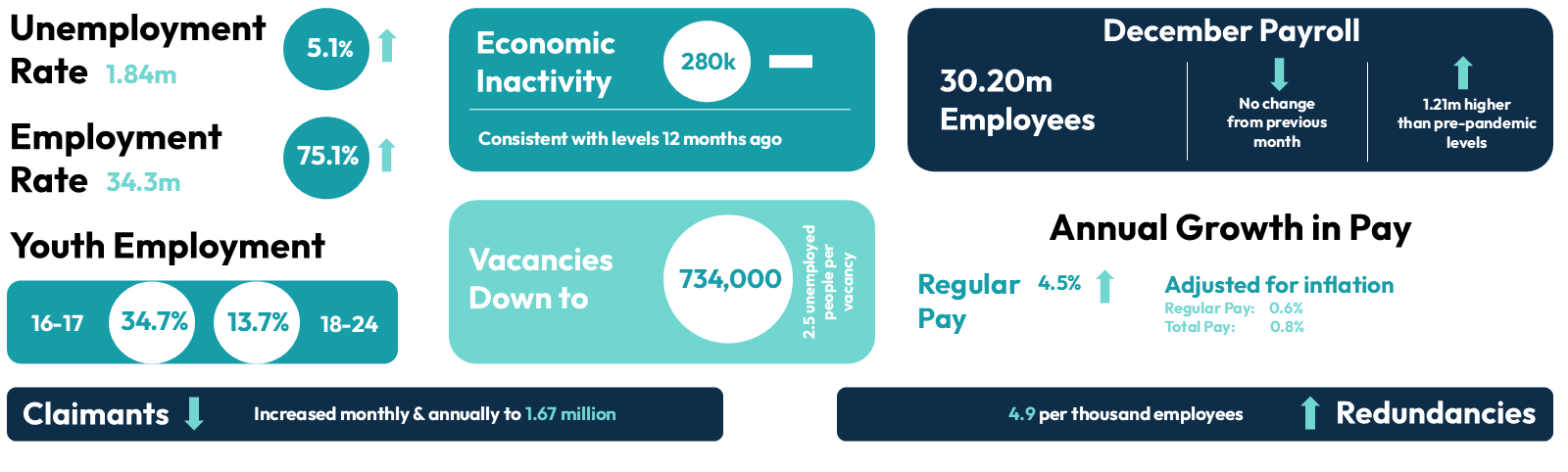
The latest ONS Labour Market Overview shows that:
The British Chambers of Commerce Quarterly Recruitment Outlook found in their latest survey that:
The survey also showed that 70% still face recruitment difficulties, which was slightly lower than the previous quarter. In regards to rising costs 22% have cut staff training, however 57% of the companies surveyed stated workforce development has stayed the same.
Changes to the welfare system will significantly increase the proportion of face-to-face assessments for both Personal Independence Payments (PIP) and Work Capability Assessments (WCA). The Secretary of State for Work and Pensions stated these reforms will deliver £1.9 billion in savings, while better supporting people into work and ensuring fairness for taxpayers.
The Government has also announced an overhaul of the Disability Confident Scheme, aiming to make participation more meaningful for employers and improve workplace inclusion for disabled people. The reforms seek to boost employment outcomes and support more than 2.8 million people currently signed off long-term sick into sustainable work.
The Government has dropped plans to make a government-issued digital ID card compulsory for workers to prove their right to work in the UK.
The DWP Youth Guarantee Advisory Panel, alongside experts from health, business and government, will support Alan Milburn in an investigation into the root causes of youth economic inactivity. With almost one million young people not in education, employment or training, a national Call for Evidence has been launched. An interim report is due in Spring 2026, supporting the Government’s ambition to expand opportunity for young people.
Analysis from Impetus estimates that high levels of youth inactivity have cost the UK £20 billion in lost GDP, with long-term “scarring” effects that disproportionately affect disadvantaged young people.
Office for National Statistics reports that 25% of UK businesses now use AI technology. With around one in seven (15%) businesses reported they were planning to adopt some form of AI technology within the next three months; this is up 2 percentage points from late September 2025 and is the largest proportion reported since the question was introduced in late September 2023.
Research from Ivanti shows that 42% of office workers now use generative AI at work, up 16 points since 2024. Nearly one in three workers conceal their AI use, often due to fears around job security and a lack of employer guidance.
The KPMG and REC, UK Report on Jobs: North of England shows that following December’s rapid decline, the downturn in permanent placements across the North of England eased notably in January. Although solid, the rate of contraction was the weakest recorded since April last year. Panellists linked the fall to recruitment freezes, but there were also reports that some employers had pressed on with hiring plans as a degree of market uncertainty had lifted following November’s Budget announcement. In contrast, the seasonally adjusted Temporary Billings Index posted below the 50.0 mark for a third consecutive month in January. The reading signalled a rapid reduction in billings received from the employment of short-term workers across the North of England and one that was the most pronounced since last April
There was another increase in the availability of permanent staff across the North of England in January, thereby stretching the current period of growth to just over two years. Redundancies were largely behind the latest uplift, panel member reports revealed. January survey data pointed to a further expansion in the supply of temporary staff across the North of England, thereby extending the current run of growth to nearly three years. Anecdotal evidence indicated that candidate availability had improved due to a combination of redundancies and mismatches between required and available skills.
The seasonally adjusted Permanent Salaries Index recorded above the 50.0 no-change mark for a second successive month in January. Recruiters based in the North of England also signalled a second successive monthly rise in average rates of pay for temporary workers in January. For the first time in eight months, all four monitored English regions saw a rise in hourly pay rates. The strongest rate of wage growth was observed in London, while the slowest was seen in the North of England.
GEM Partnership can support with your temporary and permanent staffing requirements, providing a total workforce solution, which covers both recruitment and retention of the workforce. We would love the opportunity to meet with you and provide a free training needs assessment where we can identify, any gaps in training allowing you to bolster your operations, retain talent, and unlock the potential of your most valuable asset – your employees.
https://www.britishchambers.org.uk/news/2026/01/cost-pressures-hit-jobs-market-further/
https://www.impetus.org.uk/news-and-views/neet-stats-nov-2025